
back in the saddle

I DON’T REMEMBER MUCH ABOUT the surgery.
‘You have beautiful teeth,’ the anaesthetist announced when she appeared at my bedside just outside the theatre.
I didn’t know what else to say, so I said: ‘You do too!’
It was true.
‘Your veins, though…’ She flicked my skin impatiently and pushed a temporary cannula into the crook of my arm.
Then?
Who knows.
Afterwards, I recall only disconnected moments of waking up, of being wheeled to a nondescript room on a nondescript ward featuring a window looking out onto an ugly façade, some nondescript grey-brown corner of the hospital. My husband brought me a handful of plums and a KitKat. He stood holding my hand for half an hour before returning home to the cats. I threw up trying to brush my teeth. I developed an intense and singular dislike for one of the night nurses, who ignored me when I dropped my pyjamas on the grainy linoleum, forcing me to fold my swollen abdomen like human origami as I bent to pick them up.
At some point, a bowel surgeon, someone I’d never heard of or met before, materialised at the foot of the bed to explain she’d had to remove my appendix while ‘they were in there’. It had been sent to the lab to check for malignancy.
The surgeon I knew and had met before arrived the next day, on Sunday afternoon, on account of having competed in a triathlon that morning.
‘Did you win?’ I asked.
‘Have you got any other questions for me?’ he said.
‘Yes. Can I go home?’
He asked to check the wounds, glued shut with a surgical product whose name he shared but I can’t remember. I lifted the hem of my gown to reveal five crusty incisions: one through my bellybutton and two above and below. My stomach billowed. The overall effect, in my mind, was one of harpooned sea mammal. The surgeon winced.
‘Ah. We pump you full of carbon dioxide so we can see your organs better,’ he said, accompanied by some unsettling hand gestures.
I’m a human balloon animal, I thought.
I was allowed to go home.
THAT’S ALMOST THREE WEEKS AGO. I still feel odd, not myself, pumped full of some mysterious substance. I’ve finally been out of the house, though – once because I desperately needed a haircut and had broken my thumbnail badly, once to sheepishly return to my office, the amazing job I’ve just left, to retrieve some of my junk and try not to sob as I apologised for devolving into a hot mess towards the end of my contract (if not before). Yesterday, I physically went to work and fumbled my way through several meetings, one lethargic synapse at a time.
‘When are you going to feel better?’ my mother texted me a week or so ago, as only my mother could.
‘I don’t know,’ I texted back.
I don’t know. I still don’t know.
WHEN I WAS 12 YEARS old, I got thrown off a horse – a piebald named Blackie (yes, Blackie; I lived in the country, where imaginative pet names were hard to come by) – at a family friend’s place. Blackie had bolted down the long driveway towards the house then repeatedly bucked. I became airborne, tumbling to the ground in a dramatic cartoon style. The ground happened to be scattered with wooden crates. My coccyx happened to meet a crate. For weeks after the fall, I shuffled around, barely able to walk for the pain in my lower back and buttocks. My mother surmised that I’d cracked or bruised my tailbone, but I never had it X-rayed. ('It was the nineties.’) In happier news, the injury got me out of the school sports carnival that year, and I sat on a doughnut cushion for several weeks.
When I fell, however, I was made to get back in the saddle.
‘You have to get back in the saddle,’ my friend’s mum insisted, tilting my ashen face between her hands and administering some drops of Rescue Remedy beneath my tongue. I was too much in shock, and too shy, to argue.
So, I got back back in the saddle. Or, rather, I was put back in the saddle. I was led around the yard on Blackie by a lunging rope. I got back off again.
That was 30 years ago. I’ve been horse-riding once since, and I couldn’t wait to dismount.
PEOPLE KEEP ASKING ME IF I’m sick of being at home, of being stuck in bed. The answer should be a resounding YES. But I feel as though I could sleep forever. Sometimes I feel as though I want to just sleep forever.
Stopping – completely stopping – is a funny thing. In the last few weeks, I’ve done next to nothing yet also lived a thousand lives, caught in what’s felt like a fever dream of anxiety and self-loathing. I’ve experienced similar crashes in the past, where periods of recreation or sick leave have culminated in deep depressive lows, the seemingly natural consequence of removing all the bzz-bzzz-bzzzz that often keeps my overactive mind at bay. People have warned me that general anaesthetic messes you up. Whatever the culprit, my brain keeps riffling through the last 12 months as a hand might riffle through folders in a filing cabinet: Failing IVF, spectacularly. Realising I couldn’t stay in a job I loved and was competent at, working with people I appreciated and who appreciated me, giving up my permanency and sense of stability and career progression. Succumbing to COVID, experiencing all the hope and terror of early pregnancy, the gore and tragedy of a second miscarriage. Feeling – perpetually – as if I just couldn’t keep up, couldn’t do good work, was letting everyone down, embarrassing myself, undermining relationships I valued. Wanting, actually, to stop, just stop. To fall in a heap and never climb back up again.
The saddle always feels too cumbersome, as if I am the horse and not the rider.
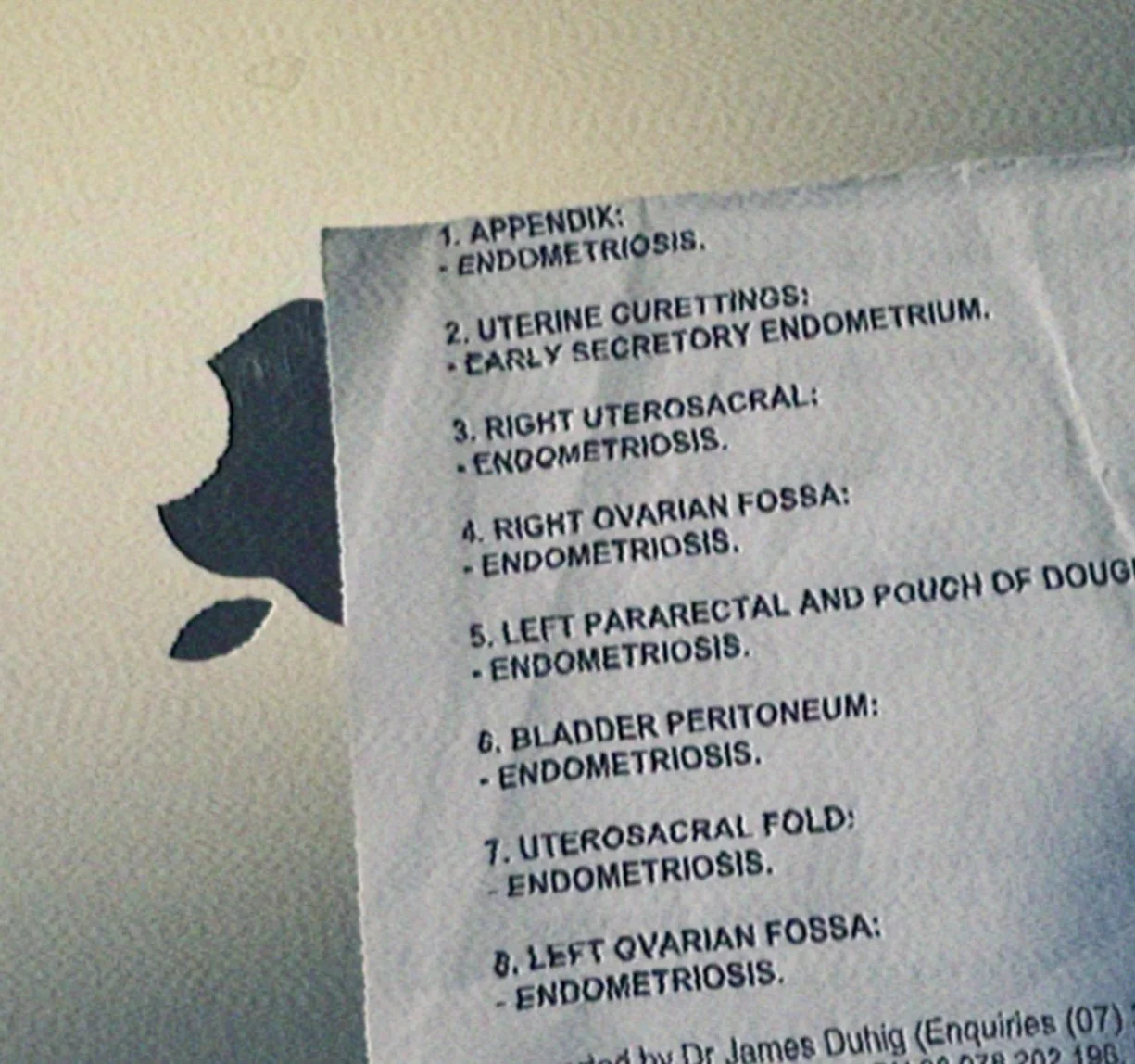
THANKFULLY, THE HISTOLOGY REPORTS came back clean in terms of serious nasties. I’ve been using the doctor’s print-out as a bookmark. There are pages of surgical notes I don’t understand, but the summary is simple, rendered in capital letters.
I cried all the way home when the print-out was still crisp and fresh, then jammed into my handbag.
‘You look so tired,’ my doctor had said. She’s known me for more than a decade now, including the year I spent in and out of hospital undergoing treatment for the intractable depression that once settled over me like a toxic fog following a run-of-the-mill wisdom tooth extraction. (General anaesthetic messes you up.)
She’s seen worse. I suppose she’s seen better, too. What could I say? I feel lucky. I feel cursed. I feel apprehensive. Why did this happen to me? Why is everyone pregnant except me? Why do the shops keep discontinuing my favourite tea?
What now?
THE TEACHING SEMESTER STARTS NEXT week, and I know what I’ll do. I’ll stand at the front of a lecture theatre and forget myself entirely. I will look out to some young, eager faces. Or young, apprehensive faces. I remember what it was like to sit among those seats myself, how large the world felt, as if I’d sat on a horse that bolted.
I was hanging on for dear life.
Because of some archival and genealogical research I’ve been doing, I’ve been thinking a lot about my grandma, the one who’s still alive, the one who’s lived, in a manner of speaking, a thousand lives and then some. This too shall pass, she often says to me still.
I’ve been thinking specifically of the time, after she got divorced again in the early 2000s, she told me she felt bereft. I looked up the word in a dictionary for good measure, which said something like lacking, deprived, or feeling great loss. Bereft comes from the past participle bereaved, derived from an Old English word meaning to be robbed or plundered in quite a violent way. The words bereaved and bereft have coexisted since around the 1400s but are now slightly differentiated in meaning: bereaved applies to loss of loved ones, bereft to circumstances.
I think my grandma is OK, if I can put it that way. She’s 93, and she spends her days doing mindless craft activities in an old folks’ home, when she’s not napping upright in a La-Z-Boy chair, her socked feet propped up on the plump footrest. We’ve plastered an entire wall of her room with family photos and all the pages she’s dutifully coloured in (mandalas, Easter baskets, bunches of flowers). She can tell me how many operational felt pens she has at any one time. Sometimes I have to lie on the floor, feeling around under her bed, to hunt down the lost ones. Perhaps she never got back in the saddle, but she kept sitting up nonetheless. My cousin and I joke that this is what she does best: she sits. We call it ‘doing a big sit’. It’s in our genes, we joke, to do the big sit.
On my left inner bicep is a tattoo, also an homage to this same grandma. It says, in a delicate handwritten script, be still. It’s a reference to her favourite hymn, ‘Be Still, My Soul’, which was penned by a German woman named Katharina Amalia Dorothea von Schlegel to the tune of ‘Finlandia’, composed by Jean Sibelius. The song is more than 300 years old. I no longer consider myself religious, but I remain in thrall to some of the music, the OLD old stuff, especially when sung by a professional choir.
It is time to move again, I know.
Baby steps.
One of my old workmates has been messaging me updates from my former branch – the usual (apparently endless) restructuring and ‘realignment’ designed to ‘curtail spending on human resources’ and establish different reporting lines. I know I made a good decision, the right decision, to leave it all behind.
Maybe it never gets easier. Maybe everyone’s just grasping the reins, waiting for the horse to slow, waiting to get off on their own terms.
This too shall pass.
By the way, does anyone know if Rescue Remedy actually does anything?
